Spectral Angle Mapper (SAM)
SAM treats each pixel's spectrum as a vector and measures the angle between it and a reference mineral spectrum. A small angle means the two curves have the same pattern. In TerraEye the output is scaled so that values closer to 1 mean a better match.
Because it compares shape rather than magnitude, SAM is invariant to how bright a pixel is, so the same material scores alike in bright and dim light.
It is not invariant to a change in the shape of the illumination. A shadowed slope is lit mostly by blue-rich diffuse skylight rather than by a dimmed sun, and any additive haze left over from the atmospheric correction tilts the whole vector. Both move the angle for reasons that have nothing to do with mineralogy.
Runs on multispectral and hyperspectral data, which makes it the workhorse when you have no EMIT coverage.
What "a match" means on a broad-band sensor
On Sentinel-2 the answer arrives at group level. Two broad SWIR bands cannot separate kaolinite from illite, because the features that distinguish them are narrower than the bands. What you get is clay-like, and reporting it as anything more specific is a claim the data does not carry.
On hyperspectral data SAM sharpens considerably, but SFF is still the better test there, for the reason on that page.
Adding the layer
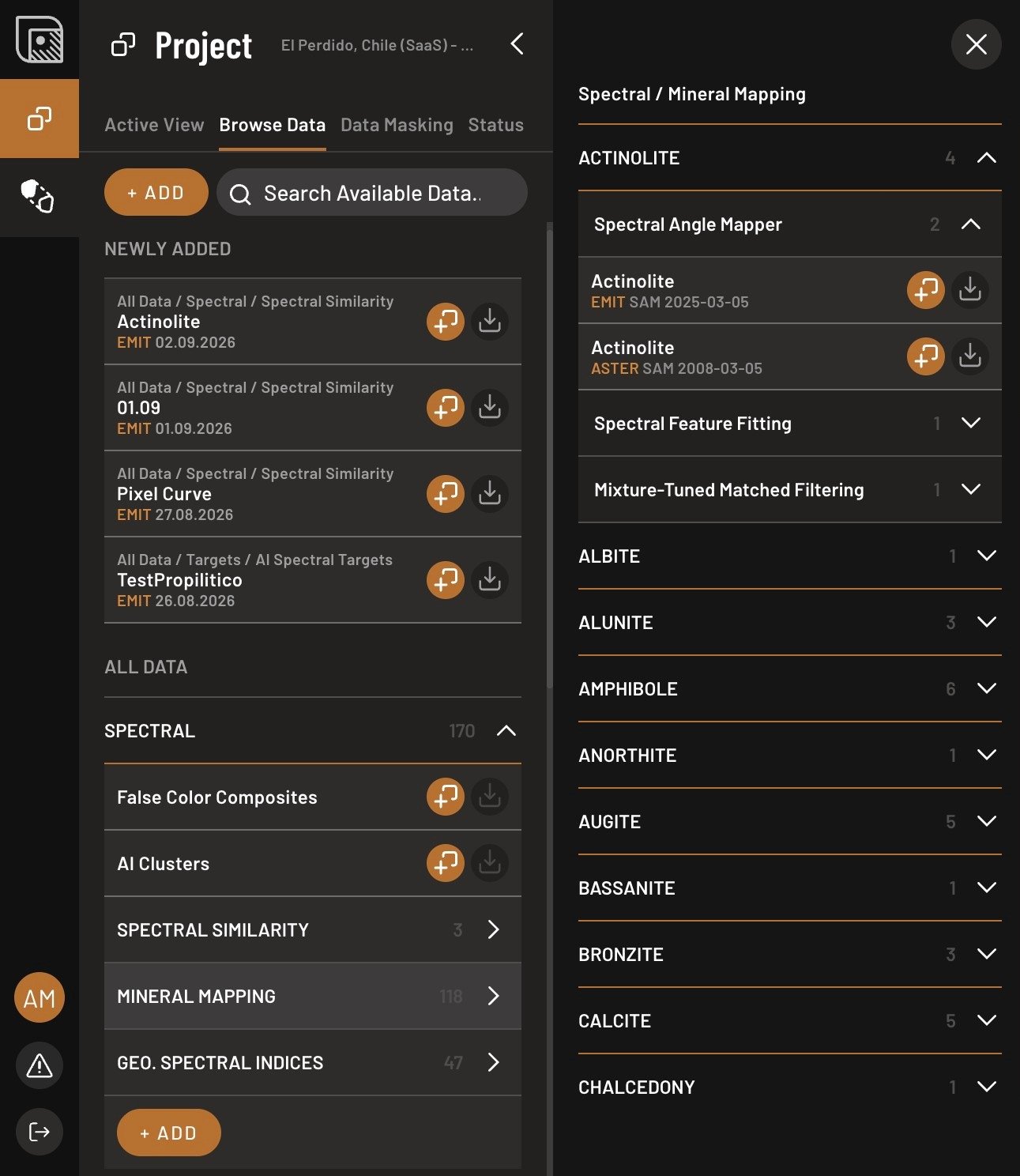
- Open the Browse Data tab, open Spectral → Mineral Mapping, pick the mineral, expand Spectral Angle Mapper, and click Add layer.
- Drag the low end of the slider up. Values closer to 1 are closer matches.
- Set the color, or switch to gradient mode, in the layer properties.
Where it misleads
SAM's weakness follows from what it measures. Whole-spectrum shape is a coarse signature, and unrelated materials can share it: a spectrum can sit at a convincing angle to your reference without having a single absorption feature in the right place. Dry vegetation is the common case in practice: its cellulose and lignin absorptions sit near 2100 nm, immediately beside the 2200 nm clay feature, and it slips past a vegetation mask that keys on green.
Illumination-insensitivity has a limit too. A slope facing away from the sun returns so little signal that shape becomes noise, which is why hillshade stays on and shadowed candidates get flagged.