Phase 7 · Validate in the Analogy Lab
Every spectral method can produce a false positive, and this is where you catch them. It's why Phase 6 handed you candidates rather than results, so don't skip it.
Confirm the curve
Every spectral layer is built from atmospherically corrected surface reflectance, which is what makes your pixel's curve comparable to a library reference at all. Within the Analogy Lab → Inspect tab click a candidate pixel to plot its curve, then add the reference curve for your mineral from the Spectral Library so the two are drawn together. Look at the dips, not the overall height: a real match has a dip in the same place as the reference. Expect yours to be shallower, because one pixel mixes rock, soil and shadow. Position matters more than depth, so a dip well away from the reference is a different mineral.
Then compare a pixel inside the zone with one outside it. If they look the same, your signal probably isn't real. A rejection isn't a failure, it's the tool doing its job: note why, and go to your next candidate.
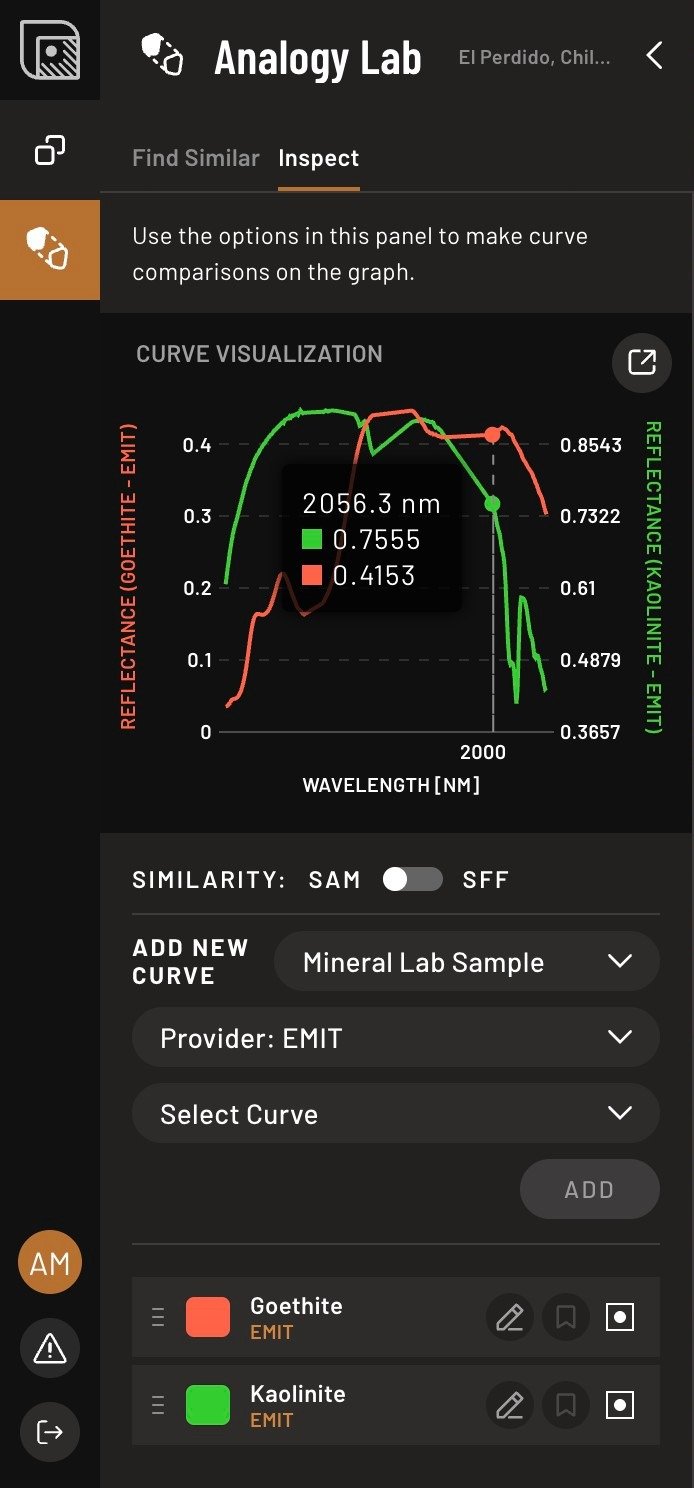
Curves worth recognizing
The red edge you learned in Phase 2 means your mask may let vegetation through. Snow is bright across the visible range and then falls toward zero past 1000 nm, which is how you tell it from bright soil. The Analogy Lab has an example vegetation curve on screen, so you can see exactly what to look for.
It catches the obvious failures, which is most of them, but not a mineral missing from the library, a surface coating like lichen, or a residual from the atmospheric correction. All three can produce a curve that lines up.
Cross-check against a reference geological site (recommended)
Do you have an area that you are specialized in and know a lot about it? Use it to discover how the result of spectral data processing compare. Use Analogy Lab to pick pixels from a known area and use them on the new exploration area. All of this allows you to understand spectral data and find places similar to what you already know.
Done when
The curve matches, you can point to the features that make you say so, and you've written down what would settle it on the ground: a sample assayed for the metal, a portable spectrometer reading, or a short hole.