Phase 9 · Define your spectral targets
Document each mineral
Draw a Shape Layer over the zone and label the mineral you detected inside it. Come back once every mineral has been through Phases 4 to 7, and all of them together through Phase 8.
Define it and export
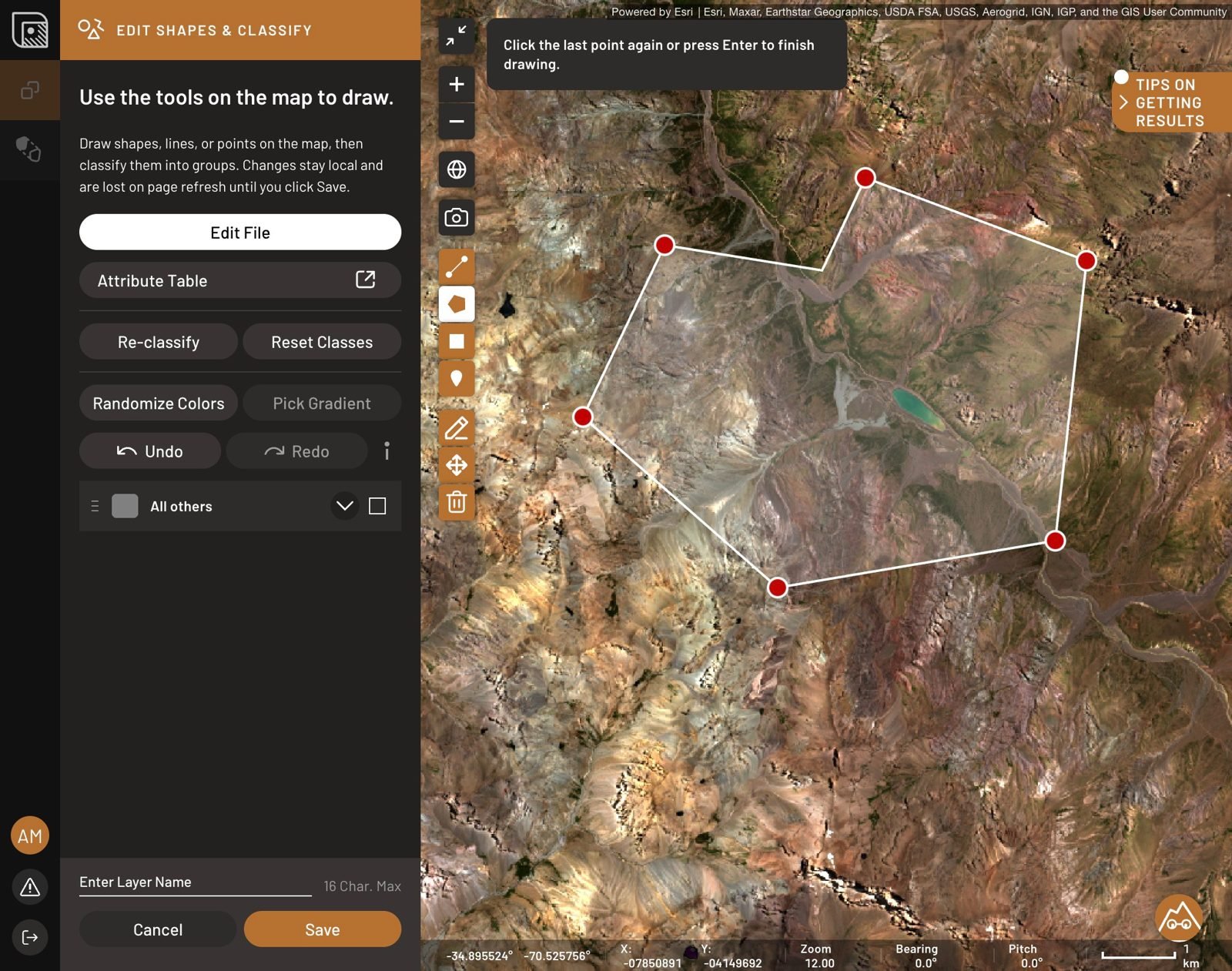
Draw a polygon over the target, note its coordinates, and export it along with the layers underneath. A candidate that failed its curve check and has no agreement between different domains (geological map, geophysics, geochemistry) will be a noise or low quality target.
If your best lead isn't spectral
Something magnetic or geochemical with no spectral component isn't a Spectral Target, and on covered ground it may still be the most interesting thing you found, if the data resolves it. A sample grid tight enough to outline the anomaly is a target; a 4 km magnetic cell is high level idea.
Or withdraw it
If your own data contradicts it, say so and withdraw it. A target you withdrew for a stated reason is worth more to whoever reads this than one you left standing.
Record what produced it
Per layer: the provider and the acquisition date, and for magnetics the grid and its cell size. Per target: the SFF or SAM value at the pixel you confirmed, the reference spectrum you matched it against, the mask and thresholds, the surviving fraction, what non-spectral evidence supports it, and whether it sits in terrain shadow or on man-made ground. Your export carries the pixels, not your reasoning, and in three months that record is the difference between a target and a colored blob you can't explain. It's also the list to ask for when someone else shows you a spectral target: a result that can't produce it isn't defensible, whoever made it.
Ignacy can write a PDF report for the area, but the record above is yours: he can't see the choices you made getting here.
Done when
Every candidate is either exported with record or written down as withdrawn for a reason.
Next: Glossary